


The Boeing 777X range has quietly received a major boost after Boeing updated the published performance specifications for all three variants of its next-generation widebody family without making a formal announcement.
The changes, which recently appeared on Boeing’s official website, show substantial increases in the advertised range of the passenger-focused 777-8 and 777-9, as well as the cargo-focused 777-8 Freighter. The revisions come as the aircraft program enters the final stages of certification ahead of the first planned customer deliveries.
While Boeing has not explained the reason behind the revised figures, the updated specifications suggest that performance testing has produced better-than-expected results.

Boeing Increases Range Across the 777X Family
The largest increase applies to the Boeing 777-8. Previously listed with a maximum range of 8,745 nautical miles (16,196 km), Boeing now advertises the aircraft with a range of up to 9,500 nautical miles (17,594 km). The increase of 755 nautical miles represents an improvement of approximately 8.6%.
Moreover, the larger Boeing 777-9 has also received a notable increase. Its published range has risen from 7,285 nautical miles (13,492 km) to 8,000 nautical miles (14,820 km), an increase of 715 nautical miles, or nearly 10%.
The cargo variant has also benefited. Boeing now lists the 777-8 Freighter with a range of 5,000 nautical miles while carrying a 110-tonne payload, compared with the previous figure of 4,400 nautical miles.
The updated specifications also include revised seating capacities. Rather than listing a single average passenger count, Boeing now provides a range based on airline cabin layouts. The 777-8 is listed with capacity for 350 to 425 passengers, while the 777-9 can accommodate 375 to 450 passengers in a typical two-class configuration.
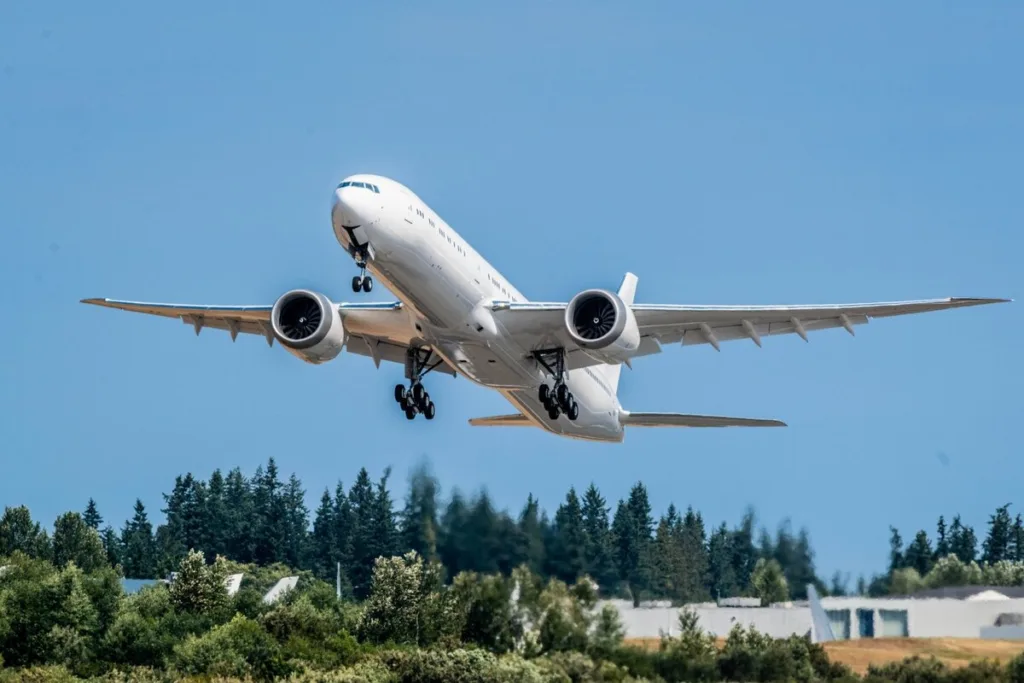
Certification Progresses Toward First Deliveries
The revised Boeing 777X range figures come as the manufacturer continues certification work with the Federal Aviation Administration.
Industry reports indicate the certification campaign has progressed into the later stages of flight testing, with Extended-range Twin-engine Operational Performance Standards (ETOPS) testing among the remaining milestones before certification is completed.
Boeing is targeting certification of the 777-9 in early 2027, followed by entry into commercial service. The 777-8 Freighter is expected to enter service roughly two years later, while the passenger 777-8 will follow afterward.
Although Boeing has not commented on the updated specifications, the higher range figures may reflect data gathered during the ongoing Type Inspection Authorization flight-test program.

Narrowing the gap with Airbus
The revised performance figures also strengthen Boeing’s position against the competing Airbus A350 family.
With a published range of 9,500 nautical miles, the Boeing 777-8 now comes much closer to the A350-1000ULR, which Airbus advertises with a range approaching 10,000 nautical miles. The ultra-long-range aircraft has been selected by Qantas for its Project Sunrise flights connecting Sydney and Melbourne with London and New York.
Meanwhile, the updated 8,000-nautical-mile range of the 777-9 moves it comfortably beyond the Boeing 777-300ER, which has a published range of approximately 7,370 nautical miles.
The new figures also extend the lead over the earlier Boeing 777-200LR, which has long been regarded as one of the world’s longest-range commercial aircraft with a published range of 8,555 nautical miles.

More Flexibility for Airlines
Additional range gives airlines greater flexibility when planning new long-haul routes.
Operators may choose to use the extra capability to launch longer nonstop services, increase passenger loads on existing routes, or carry additional cargo while maintaining current flight distances. The improvements also provide airlines with more operational options during adverse weather or when route restrictions require longer flight paths.
For cargo operators, the increased range of the 777-8 Freighter could allow additional city pairs to be served nonstop while carrying substantial payloads, improving fleet efficiency on long-haul freight networks.

Editor’s Take
The updated Boeing 777X range figures represent one of the most significant specification changes to the program in recent years. An increase of more than 700 nautical miles across both passenger variants is substantial and could improve the aircraft’s appeal as airlines evaluate future fleet investments.
However, Boeing has yet to explain what drove the revised numbers. Whether the improvements result from flight-test data, aerodynamic refinements, weight optimization, or revised mission assumptions remains unclear. Until the manufacturer provides additional details, the updated specifications should be viewed as published performance targets rather than fully explained technical changes.
What is clear is that the revised figures further strengthen the 777X’s position in the ultra-long-haul market and intensify its competition with Airbus’ A350 family as both manufacturers prepare their newest widebody aircraft for the next generation of long-haul operations.
Please join our Telegram Channel for the latest aviation updates.

1 Comment
Pingback: Sydney Airport Wins Approval for $70 Billion Expansion Plan - Aero World